

Article by Hillary Hoffman | Photos Kathy F. Atkinson and courtesy of conference organizers
UD convenes regional engineering educators to expand engineering’s impact beyond the classroom
On March 27–28, engineering educators stepped outside their classrooms to learn from one another. The University of Delaware College of Engineering brought together 130 faculty, K-12 educators, students, community representatives and industry partners for the 2026 spring conference of the Middle Atlantic Section of the American Society for Engineering Education (ASEE).
Organized around the theme From Classroom to Community: Strengthening Engineering Education through Collaboration, the conference convened on UD’s Science, Technology and Advanced Research Campus for presentations, a poster session and interactive workshops focused on collaborative learning and connecting classroom experiences with community impact.
“Hosting the ASEE Middle Atlantic Section Conference reflects UD’s growing reputation as a leader in connecting engineering education with real-world impact,” said conference organizer Alexander De Rosa, associate professor of mechanical engineering. “UD has built a strong and growing community of faculty advancing engineering education research and practice.”
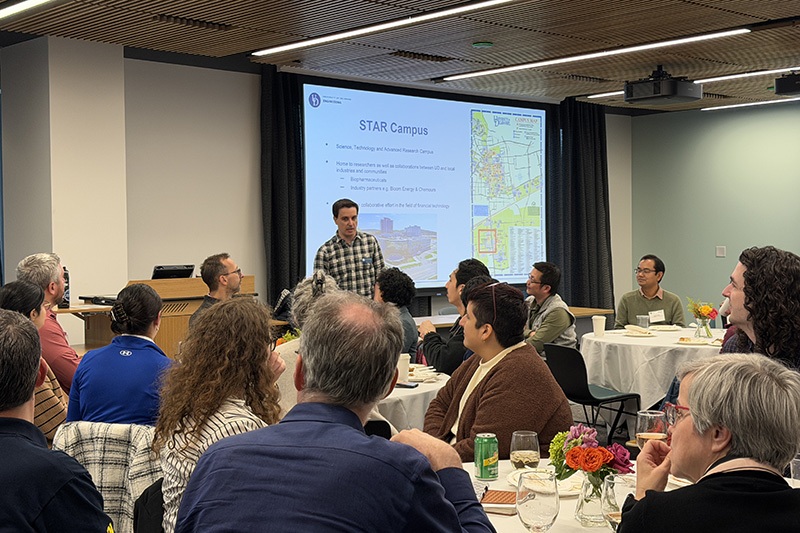
De Rosa (standing, checked shirt) welcomes conference attendees.
One highlight of UD’s presence at the conference was the Engineering Education Ecosystem (E3), a newly revitalized initiative positioning UD as a partner, resource hub and driver of innovation in engineering education from K–12 through higher education. E3 sponsored a conference lunch that helped create space for building connections and exchanging perspectives.
“A strong workforce depends on the educational systems that train the next generation of engineers,” said Sarah Rooney, associate professor of biomedical engineering and leader of the E3 revitalization effort, which is in the early stages of strategic planning. She said the conference provided an important opportunity to grow the E3 network, better understand regional priorities and exchange ideas.

Rooney converses with another conference participant.
Friday afternoon’s kick-off events included a workshop on implementing collaborative learning in the classroom led by experts from the UD Center for Teaching and Assessment of Learning, followed by a tour of UD’s Design Studio, a hub for hands-on innovation, digital fabrication, rapid prototyping and student collaboration, on UD’s central campus.
Saturday’s program opened with a keynote address by Judson Wagner, whose career arc brought him from classroom to community and back again. A former district STEM director and co-chair of Delaware’s Governor’s STEM Council, Wagner holds a doctorate in education and is now an assistant teaching professor of physics at Elizabethtown College, where he is developing a peer-led model that helps students build skills as communicators, collaborators and leaders.
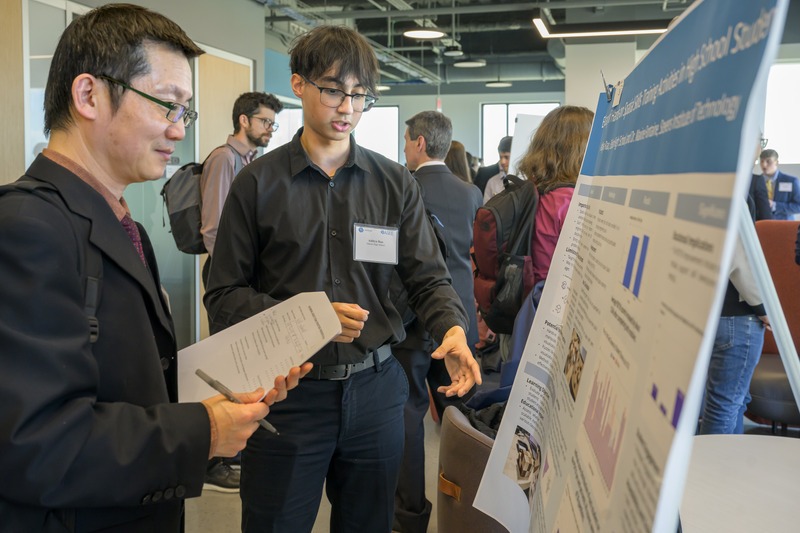
The conference featured 35 paper presentations and 13 “great ideas for teaching or talking with students” (GIFTS), along with 15 posters. A Saturday workshop hosted by UD’s Engineers Without Borders chapter gave students and faculty a chance to share lessons from their collaborations with local communities in the U.S. and abroad.
“I hope people left the conference feeling energized after seeing the great work others are doing and with ideas they can bring back to their own classrooms,” said De Rosa. “I also hope they expanded their networks and found new collaborators to continue working with beyond the conference.”
Haritha Malladi and Ashish Asutosh, both assistant professors in the Department of Civil, Construction, and Environmental Engineering, served as program chairs. Wendy Jordan and Rebecca Gregan of the Dean’s Office provided administrative support. Faculty collaborators from UD’s College of Engineering and School of Education also contributed to the conference.