In laboratories across the University of Delaware, scholars are uncovering new insights about the human body: how a compound in red wine might protect joint cartilage from damage, how bad posture wears down the discs in your back, how your knee heals after an anterior cruciate ligament (ACL) tear, and more.
Faculty Spotlight: April Kloxin
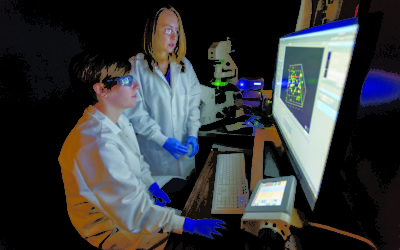
April Kloxin, assistant professor of chemical and biomolecular engineering and materials science and engineering at the University of Delaware, is the ACS Division of Polymer Chemistry Researcher of the Month for May 2018.
Day Earns NSF CAREER Award
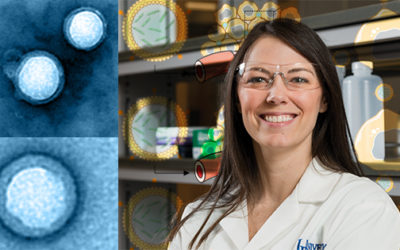
She is engineering membrane-wrapped nanoparticles for targeted ribonucleic acid (RNA) delivery to breast cancer cells.
Making Powerful Batteries Safer, More Efficient
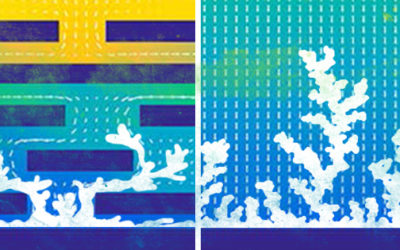
Mechanical engineering professor Bingqing Wei leads team to curb formation of harmful dendrites in lithium metal batteries.
Adapting apps for high-powered computing
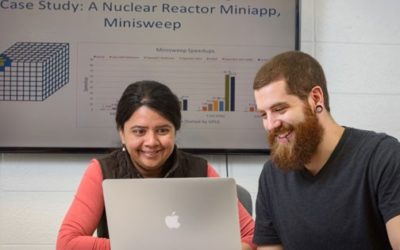
A modern-day version of the 20th-century space race, companies and governments worldwide are scurrying to build an what’s called an exascale computer, which could do a billion billion calculations per second. UD computer scientists team with Oak Ridge National Lab to program apps for next-generation supercomputer.
Searching for the Big Picture
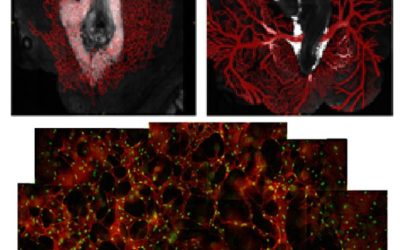
Essential information about medical discoveries is often buried inside the graphs, charts, photographs, and other images that illustrate research journals. Large-scale analysis of images along with the text could soon be possible, thanks to a $1.9 million grant from the National Institutes of Health.
A prominent pair in polymers
John Rabolt and D. Bruce Chase have received the 2018 Award for Cooperative Research in Polymer Science and Engineering from the American Chemical Society Division of Polymeric Materials Science and Engineering.
Programming DNA to deliver cancer drugs
DNA has an important job—it tells your cells which proteins to make. Now, a research team at UD has developed technology to program strands of DNA into switches that turn proteins on and off.
Understanding Porous Materials
More than 30 states have shale formations that harbor natural gas underground, but industry experts can’t agree on exactly how much fuel is inside. A new method developed at UD could help quantify these untapped reservoirs.
Five Win Support from UD Research Foundation
The new awards give researchers traction in the early stages of projects that support strategic initiatives and allow them to develop ideas and build a stronger foundation for future studies.
Breaking the Rules of Brain Cancer
The collaboration of a chemical engineer and a neurobiologist has produced a new and freely available computer program that predicts cancer cell motion and spread with high accuracy.
Detecting Hidden Threats
UD professor and post-doctoral fellow are developing technology to detect explosive devices from a distance, thanks to a five-year, $1M grant from the U.S. Army Research Office.