

Article by Amy Cherry
UD’s Big Ideas Challenge advances novel approach to help people with Achilles tendinopathy keep moving
In Elisa Arch’s Orthotics and Prosthetics for Enhanced Mobility Lab, students are exploring novel approaches to help those with Achilles tendinopathy (AT) return to daily activity more quickly.
The common overuse injury impacts as many as 24% of athletes, according to University of Delaware-led research published in The Journal of Athletic Training, and is increasingly seen in sedentary individuals and linked to metabolic disorders and diabetes.
“Because it’s an overuse injury, modification of activity is beneficial during rehabilitation,” said Arch, associate professor of kinesiology and applied physiology in UD’s College of Health Sciences.
However, a lack of tendon loading can lead to tendon atrophy.
“The elasticity of the tissue changes and sometimes never recovers,” Arch said. “Being inactive during rehab can exacerbate comorbidities and be very detrimental to a person’s overall health.”
Outside of physical therapy, which is prescribed for these injuries, it is harder to modulate tendon load during daily living. That got Arch, whose expertise lies in orthotics, thinking.
“Can we use an ankle-foot orthosis (AFOs), which braces the ankle joint, to control the load on the tendon?”
Working alongside Stephanie Cone, assistant professor of biomedical engineering, and tendon expert Karin Grävare Silbernagel, professor of physical therapy, and with seed funding from UD’s Big Ideas Challenge, Arch is pioneering this research while training students in hands-on innovation.

A close-up of the ankle-foot orthosis (AFO), developed by Biomotum. The AFO will be tested in 29 study participants, marking the first time an AFO has been tested to help people with Achilles tendinopathy.
“AFOs have never been tested in people with Achilles tendinopathy,” Arch said. “I’ve seen heel wedges, lifts, and foot orthotics used to address Achilles tendinopathy with little success, but no one thinks about AFOs, and AFOs are all I think about.”
Redefining rehab
Students in Arch’s lab are exploring how a specially designed AFO from Oregon-based medical device start-up Biomotum can help people with AT regain mobility. The device, used alongside sensors, is tested on a split-belt treadmill, allowing students to collect precise data on tendon load while experimenting with stiffness adjustments that could enhance rehabilitation outcomes.
“AFOs are like a spring, and the tendon is like a giant rubber band,” explained Arch. “As the ankle tries to bend, the rubber band controls how much it bends. The AFO provides resistance to bending, which is what your calf muscles and Achilles tendon also do.”
The Biomotum device allows separate adjustment of dorsiflexion and plantarflexion stiffness, which is key for AT rehab and may help avoid adverse side effects. Arch hypothesizes that higher stiffness provides greater tendon offloading and that gradually reducing stiffness as the tendon heals could support recovery.
Using stiffness to assist an injured joint is a relatively new concept. Arch notes in the clinic that an AFO’s stiffness is not traditionally quantified.
“An orthotist casts a person’s limb, builds an AFO, tests it out, and trims and adjusts through trial and error,” Arch said. “Measuring stiffness and gathering data on AFOs is still emerging as researchers and clinicians recognize the need for data on the devices’ mechanical properties.”
Training the next generation of biomechanics leaders
Zahra McKee, a fourth-year biomechanics and movement science doctoral student, leads the lab’s data collection efforts, gaining hands-on experience in designing and executing innovative experiments.
“I’ve grown so much as a researcher. I’ve learned how to best ask questions to design experiments with the most impact and how to analyze data,” said McKee. “Using technical tools like motion capture, force plates, and ultrasound to study how the tendon responds to movement has been incredibly valuable.”

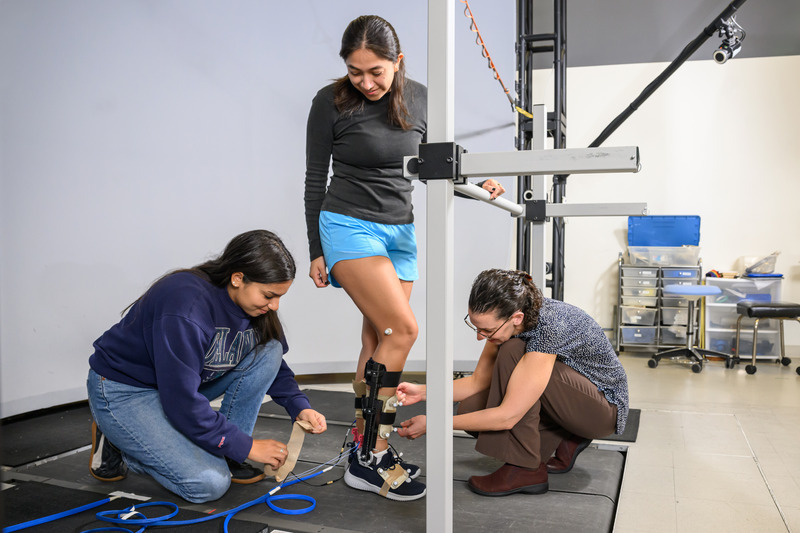
Iris Sanchez, a senior mechanical engineering major, walks on a split-belt treadmill to demonstrate how an ankle-foot orthosis (AFO) can be used to control load on the tendon in people recovering from Achilles tendinopathy. Sanchez works in the lab alongside mentors Elisa Arch (right), associate professor of kinesiology and applied physiology, and biomechanics and movement science doctoral student Zahra McKee, who are pioneering this research.
Through this research, McKee and Arch mentor students like Iris Sanchez, a senior mechanical engineering major.
“I’ve fallen in love with the prosthetics and orthotics world,” said Sanchez, a first-generation college student. “It’s so rewarding to take part in research that helps people in their daily lives. My time in the lab has deepened my understanding of anatomy and how the body generates movement, bridging the gap between the mathematical world of engineering and human anatomy.”
UD’s Big Ideas Challenge supports projects like this, providing students with immersive, hands-on training in research, innovation, problem-solving, and translating ideas into real-world solutions.
Without seed funding from the Challenge, gathering pilot data for future National Institutes of Health (NIH) grants wouldn’t be possible.
“If we can prove feasibility in concept, which the NIH wants to see, we could get larger awards,” said Arch, who believes her research may be of interest to the Department of Defense. “AT is a common overuse injury in active service members. If we can put an AFO on them and have them up and active earlier in rehab, they can return to duty sooner.”
McKee adds that up to 20% of AT patients continue to have symptoms for a decade.
“We want to help people return to activity sooner and with less pain. When you’re restricted from your regular activities, it impacts quality of life and cardiovascular health,” McKee said.