
UD chemical engineer Catherine Fromen honored with DDL’s Emerging Scientist of the Year award for advancing aerosol drug delivery
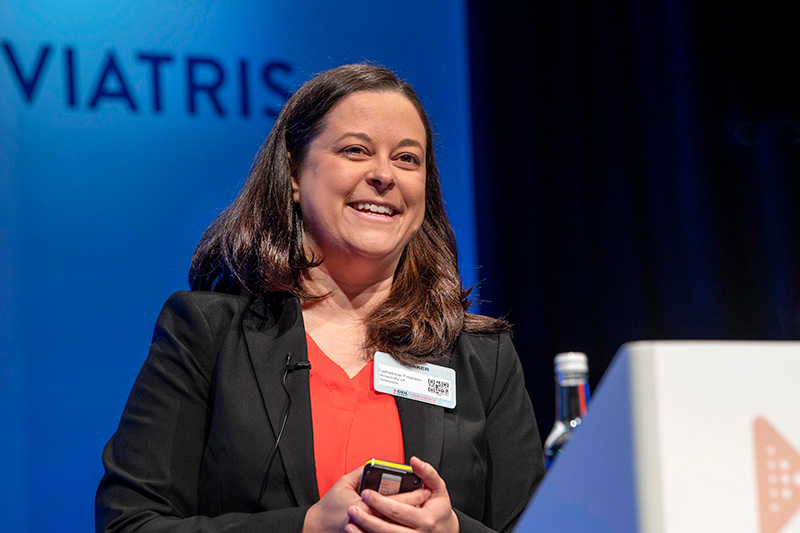
Medicines are often swallowed or injected, but in many cases, the most direct delivery path may be through the lungs. University of Delaware chemical engineer Catherine Fromen’s research seeks to expand the repertoire of inhaled therapies and vaccines. She was recently recognized with the 2025 Drug Delivery to the Lungs (DDL) Emerging Scientist award.
“For lung diseases, inhaled medicines go straight to the source of the problem,” noted Fromen, Centennial Associate Professor for Excellence in Research and Education with a joint appointment in the Departments of Chemical and Biomolecular Engineering and Biomedical Engineering. “Yet outside of treating asthma, aerosolized drugs aren’t the first go-to.”
Fromen’s lab studies how different medicines direct lung immune cell responses and develops advanced lung models to predict how inhaled drugs spread through the airways. She highlighted progress in both areas during her award lecture at the DDL2025 conference in Edinburgh, Scotland, on December 11.
Aerosolized particles interact closely with lung immune cells that are involved in both protection and disease progression. Fromen’s team engineers nanoparticles to study these cells and guide their fates. They have developed aluminum-based nanoparticles with potential as inhaled vaccine adjuvants, substances that boost vaccine-elicited immune responses. Other work has revealed insights underscoring the need for more personalized approaches to aerosol drug delivery, such as age-dependent differences in nanoparticle uptake by lung immune cells.
“You need to get the medicines to the right spot and get the right cells to engage,” explained Fromen. “Current inhalers are a bit like throwing paint on the wall and hoping that enough sticks. We need better methods to predict how medicines will work in the lung before they get to human testing so our inhalers can be much more precise about the complex biological responses that we want to achieve.”
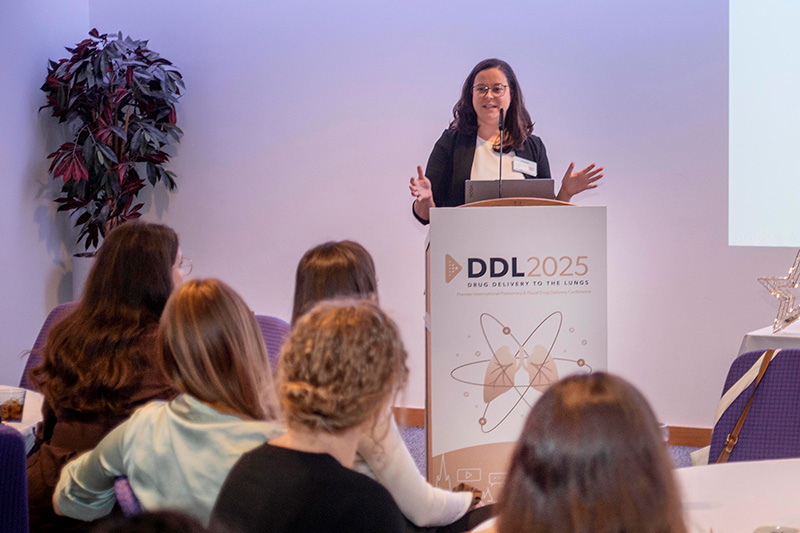
Fromen also spoke to the DDL New Researcher Network, offering early-career researchers insights into her career path.
The fate of an aerosol medication in the lung depends on the drug formulation, delivery method and patient. To address this, Fromen and colleagues developed an adaptable 3D lung model that replicates realistic breathing maneuvers and allows researchers to evaluate aerosol therapeutics under various conditions. They are also developing lab-on-a-chip models that mimic diseased lung tissue, helping reveal how the location where particles land can shape immune responses and influence how well a therapy works.
Fromen’s integration of chemical engineering, immunology and materials science helped earn her the 2025 DDL Emerging Scientist award, which recognizes significant early-career contributions to inhalation science. In addition to her award lecture, Fromen was honored with £1,000 in prize money and a commemorative plaque.
“I was over the moon when I learned I was the 2025 award recipient,” Fromen said. “The past winners are people I’ve admired across this incredibly diverse field—clinicians, device makers, formulation scientists from around the world. It’s amazing to be counted among them as a chemical engineer. And because DDL was the first conference I ever attended as a graduate student, being honored here now feels like I’ve come full circle.”
Looking ahead, Fromen’s lab seeks to tailor inhaled immunotherapies to specific diseases and conditions, from asthma to lung cancer. “Inhaled medicines should be the front line for many more diseases, as opposed to an afterthought,” Fromen said.