

UD receives $2.4 million from DOE to help develop energy-efficient neuromorphic computing systems
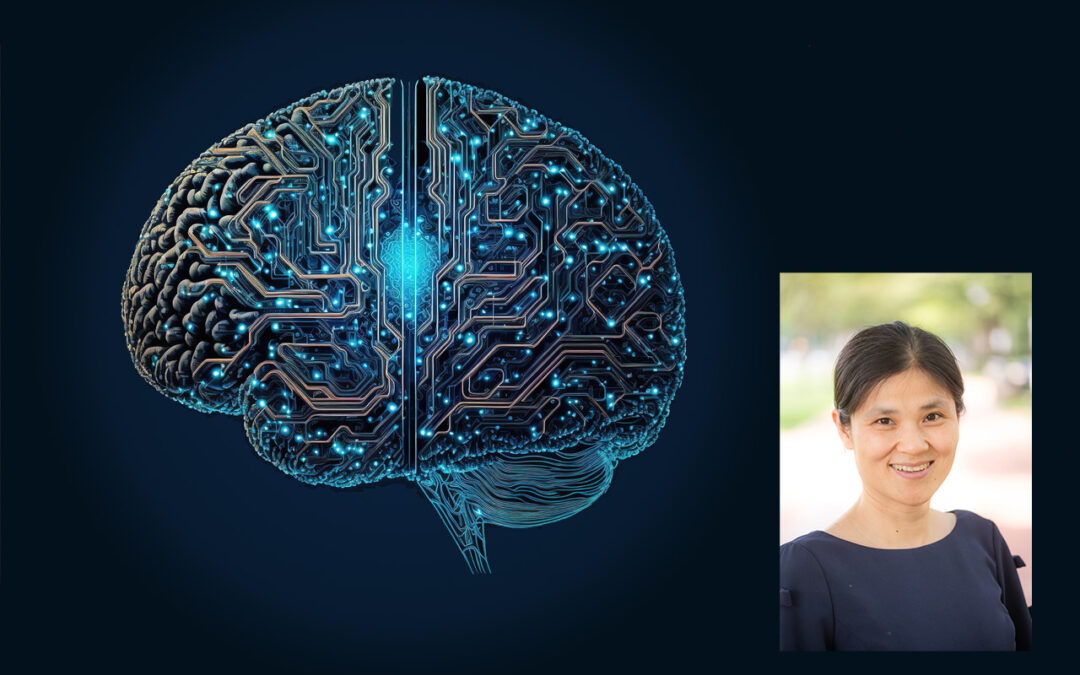
Today’s computers rely on energy-hungry digital circuits that process information strictly as ones and zeros. The human brain, in contrast, uses analog signals to do far more with less power.
By designing hardware modeled after the brain, the field of neuromorphic computing seeks to build computer systems that learn and recognize patterns with far less energy consumption.
Yuping Zeng, associate professor of electrical and computer engineering at the University of Delaware, is part of a multi-institutional team supported by the U.S. Department of Energy to develop such systems. Other leaders of the approximately $12 million, five-year project include Yiran Chen of Duke University, Gina Adam of George Washington University and James Ang of Pacific Northwest National Laboratory. Zeng’s lab will receive $2.4 million to develop novel devices.
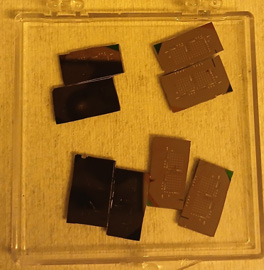
Computer chips with FeFETs. Courtesy of Yuping Zeng.
Zeng’s team has created a new kind of computer switch that can both remember and process information. These devices, known as ferroelectric field-effect transistors (FeFETs), will serve as the foundation of the neuromorphic computing system. Conventional devices rely on silicon-based CMOS (complementary metal-oxide-semiconductor) technology. Zeng’s FeFETs use titanium oxide, a ferroelectric material that can retain electric memory without power.
“In regular memory devices, each cell can only store one bit—a zero or a one. But our device can store multiple bits in the same place,” explained Zeng. “Compared with today’s silicon-based chips, FeFET devices save energy, compute faster and can even do in-memory computing, where the device both stores and processes information at once.”
For the DOE project, UD’s role is to deliver the novel devices at the heart of the system. Partners at George Washington University will design architecture and software to integrate the FeFETs with CMOS circuits provided by Duke. The most promising “building blocks” for a neuromorphic computer will be evaluated at Pacific Northwest National Laboratory.

Yuping Zeng and postdoctoral researcher Chandan Samanta in the laboratory testing ferroelectric field-effect transistors. Courtesy of Yuping Zeng.
Zeng’s team also will develop new ferroelectric devices based on gallium nitride and germanium tin. Gallium nitride can handle higher power and speed, while germanium tin behaves as a p-type material and titanium oxide as n-type.
“Combining p-type and n-type materials would make the computer system even more efficient,” said Zeng. “In that case, we could build the computer architecture entirely from these emerging devices, achieving much faster and more energy efficient computing. That’s the ultimate goal.”

Postdoctoral researcher Elia Palmese, who contributed to device measurement, and undergraduate student Austin Biaselli, who contributed to device simulation, with Yuping Zeng. Courtesy of Yuping Zeng.