

Kingsley Royal
Major: Biomedical engineering
Graduation Year: 2028
Hometown: Atlanta, Georgia
Pronouns: He/him
Kingsley Royal
Q: Why did you decide to major in biomedical engineering?
Royal: During my return-to-play rehabilitation after tearing my ACL and lateral meniscus in my junior year of high school, I became fascinated by lower limb biomechanics, injury science research, medical devices and methods for enhancing the human body after injury. This experience introduced me to biomedical engineering and made me realize that with dedication I could make a meaningful contribution. It transformed a painful moment into a source of passionate motivation.
Q: How do you spend your time outside of class and research?
Royal: I was a member of the football team during my first two years at Delaware, so much of my time was dedicated to practices, lifts, film sessions, games and other student-athlete commitments. I also worked part time from the spring of my freshman year through the summer before my junior year.
In my free time, I enjoy fishing around White Clay Creek and playing pickleball at the courts by the Reservoir. I think it is important to find activities that allow you to step away from the pressures of school.
Q: What advice do you have for incoming first-year engineering students?
Royal: Get out and explore. That might mean joining a club, learning about a lab that interests you or simply trying a new restaurant on Main Street. There are so many opportunities on campus to grow not only as an engineer, but also as a person.
Second, make an effort to connect with people! College is one of the few times in your life when you are surrounded by so many people working to build the foundation for their futures, so take advantage of it. Finally, there may be times when you struggle or things do not go your way. As long as you focus on what you can control, your attitude and your effort, you will be okay.
Q: In summer 2026, you participated in the Children’s Hospital of Philadelphia (CHOP) Research Experience for Undergraduates (REU). What drew you to the program, and what was the highlight of your experience?
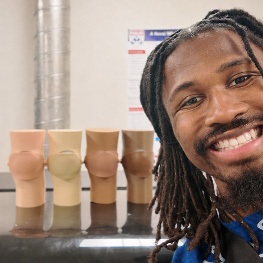
Royal: I was initially drawn to the REU because it offered the opportunity to work on injury-prevention research at one of the world’s leading pediatric hospitals. The project focused on developing pediatric knee trainers to evaluate physicians performing the patellar tap test, an examination used to detect knee effusions. Having experienced a traumatic knee effusion myself, I felt that the project was a perfect opportunity to develop my engineering skills while contributing to a solution that held personal meaning for me.
The highlight was working in a hands-on, learning-by-doing environment. Seeing how far the project had come at the end of the 10 weeks made me incredibly proud, especially because I understood how much persistence, problem-solving and collaboration it took to get there. The most rewarding part was knowing that my work had the potential to benefit both physicians and patients. The knee trainers could ultimately support more confident and effective patient care.
The project also gave me a greater appreciation for the work behind the scenes in healthcare. Patients may only see the final examination or treatment, but reaching that point often requires extensive research, design, testing and collaboration. Contributing to that process showed me how engineering can make a meaningful difference in healthcare.
Q: What new technical, research or professional skills did you develop during your REU?
Royal: On the technical side, I gained experience with CAD modeling, 3D printing, microcontrollers, hardware design, silicone pouring, soldering and calibration verification. These skills allowed me to move through the full design process, from developing concepts to building and testing physical prototypes.
As a researcher, I strengthened my ability to analyze scientific literature, interpret data, troubleshoot challenges, maintain detailed records, develop prototypes and communicate findings. The project taught me that research is rarely a straight path and that progress often depends on patience, adaptability and a willingness to learn from unexpected results.
Professionally, the experience helped me become more confident in my ability to lead a project while remaining open to feedback and guidance.