

Devika Ramakrishna
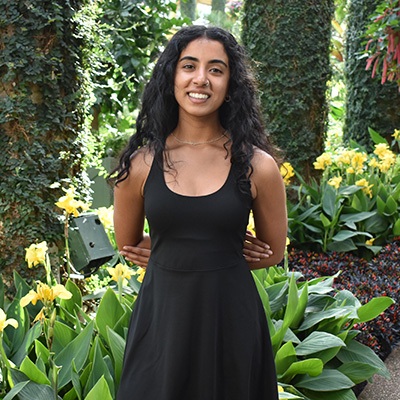
Major: Honors chemical engineering
Minor: Applied music – percussion
Graduation Year: 2029
Hometown: Dallas, Texas
Pronouns: She/her
Devika Ramakrishna
Q: How do you spend your time outside of class and research?
Ramakrishna: My favorite way to spend free time is to play music—some time in a practice room is the best way to de-stress and enjoy myself after a tiring day of class and lab! I am a percussion minor at UD, so I love playing in ensembles with my friends, developing my soloist skills and having fun as an amateur pianist and singer. I also enjoy practicing yoga with the UD Yoga Club, spending time outdoors and playing new board games!
Q: What advice do you have for incoming first-year engineering students?
Ramakrishna: My advice to new engineers is to explore opportunities outside of STEM. I love chemical engineering, but I would quickly burn out if all I did was chemistry and math all day. Trying new arts and sports, expanding your knowledge and picking up cool skills will keep your brain from feeling like an overworked calculator. College is a time to study hard, but it’s also a crucial period for personal growth. Don’t be afraid to try random new things and make plenty of mistakes.
Q: In summer 2026, you participated in an NSF Research Experiences for Undergraduates program at Texas A&M University. What was your biggest takeaway?
Ramakrishna: Working on an interdisciplinary National Science Foundation initiative has really put into perspective how fascinating and challenging it is to build a process flow. I worked with the Carbon Utilization Redesign for Biomanufacturing (CURB) center, which brings together researchers whose focus ranges from chemistry to economics. Every step of the conversion from raw carbon dioxide to its intricate value-added products requires meticulous thinking and creativity. Then, all of the steps have to converge into a seamless, industrially applicable process.
Q: Your summer research focused on protecting enzyme catalysts used in carbon upcycling reactions. What did you find most interesting about the project or the science behind it?
Ramakrishna: I really enjoyed my exposure to materials science and its applications in reaction design. I focused on optimizing a porous material called a metal-organic framework (MOF) to encapsulate enzyme catalysts, enabling their reuse in large-scale carbon dioxide conversion processes. Delving into MOFs really allowed me to expand how I think about physical and spatial chemistry. No one knows exactly what goes on with atoms at the molecular level, but I have definitely improved at taking an educated guess!