

Aratrika Ghosh
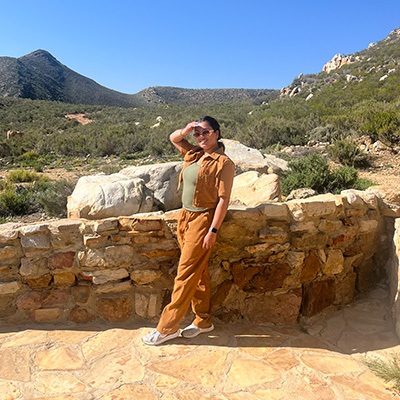
Major: Honors biomedical engineering
Minor: Biomechanical engineering
Graduation Year: 2028
Hometown: Bear, Delaware
Pronouns: She/her
Aratrika Ghosh
Q: Why did you decide to major in biomedical engineering?
Ghosh: I became interested in high school, as it combines my passion for the sciences with my love for working hands-on. As I researched the major at UD specifically, I loved how the curriculum allows you to start in your major right away and begin cell and tissue engineering as a freshman!
Q: What has been your favorite course at UD so far?
Ghosh: My favorite course so far has been our medical devices class with Sarah Rooney, as we got to work with surgical staplers with Johnson & Johnson! Throughout the class we learned
about the regulatory pathways and how medical devices are designed and eventually put on the shelves. It was a very engaging and relevant class for our major, and I really enjoyed it.
Q: How do you spend your time outside of class?
Ghosh: I love to hike, read books and volunteer as a therapy team with my dog at the hospital. She loves to walk around the hospital and say hi to patients and staff who need some extra love.
Q: What advice do you have for incoming first-year engineering students?
Ghosh: The best way to stay on track is to have a calendar or planner to keep all your assignments and events organized. When you figure out what works for you, everything will fall into place. Remember to also have fun. Don’t take this time for granted.

Ghosh traveled to South Africa in 2026 to explore the importance of cultural awareness in engineering and product design.
Q: In summer 2026, you traveled to South Africa with seven other biomedical engineering students. What interested you about the opportunity, and what was a highlight of the experience?
Ghosh: As an aspiring medical student, I really wanted to explore and learn about healthcare outside of the United States. The highlight of the experience ended up being the conversations I had with the community members as well as the physicians in South Africa. Every individual’s story and thoughts were so important and powerful. It is necessary for engineers and scientists to be culturally aware and open when designing products or giving care.
Q: During your trip, what did you learn about how local needs and perspectives can influence medical-device design?
Ghosh: It is incredibly important to take into consideration the available resources and equipment that everyday people have access to when trying to address a gap in the system. I learned that the first step to designing any kind of product is to talk with the intended users and the providers. From these discussions you can really get an idea of what is valuable and relevant to them.
Q: Was there a particular conversation or experience that changed how you think about engineering or healthcare?
Ghosh: One of the conversations that really stuck with me was with some after-school teachers from the Amy Foundation when we discussed if children at the after-school program believed that they could become doctors and give back to their communities. The teachers said that the children have a hard time believing that they themselves could be doctors—that it seems out of reach for them. This conversation left me reflecting on the privilege that some of us have simply by living somewhere with more resources and opportunities. I will always remember that even believing you can become a doctor or engineer is something we should not take for granted.
Q: How did your experience in South Africa influence the kind of biomedical engineer you hope to become?
Ghosh: During and after the program, I feel very moved by all the people I met and how resilient and proud they are. Just by meeting with communities different than our own, we can really begin to understand what it means to be an engineer and create the technology and devices that will ultimately go to these communities. I know that this program will help me in being more mindful and implementing the idea that biomedical solutions must be designed around environments in which they will actually be used.