

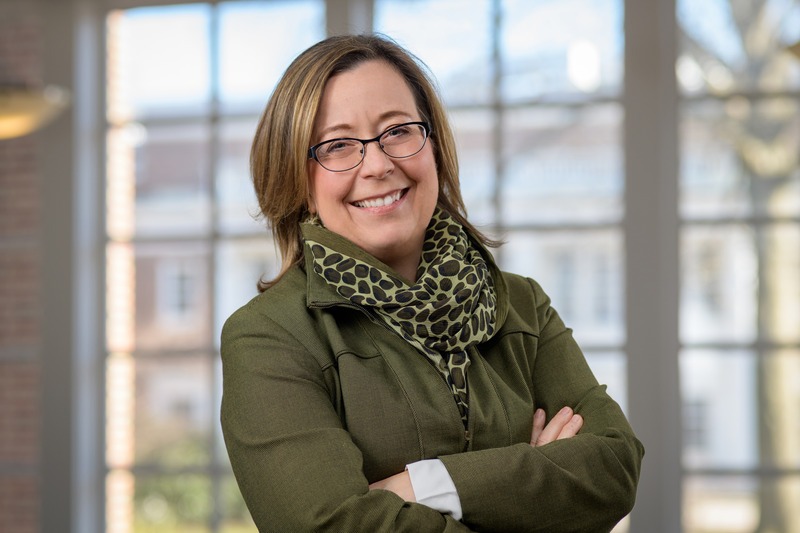
Article by Hillary Hoffman
International leadership role recognizes Dawn Elliott’s contributions to research, education and community
Every four years, researchers from across the globe travel to the World Congress of Biomechanics to share discoveries, spark collaborations and return home with new ideas. This year, Blue and Gold Distinguished Professor of Biomedical Engineering Dawn Elliott brought something more back to the University of Delaware: a seat on the executive committee of the World Council of Biomechanics.
With her election to the role of treasurer at the 2026 World Congress, which took place July 11–15 in Vancouver, Elliott became the only member of the executive committee based in the United States. Since her election to the council in 2022, she has been one of a handful of U.S. delegates.
The appointment recognizes a career that has extended well beyond Elliott’s own research, from building academic programs and research infrastructure at UD to helping shape the international biomechanics community.
“Dawn’s peers recognize what we see every day. She brings people together around ambitious ideas and builds the programs, partnerships and communities that allow them to endure,” said Pamela M. Norris, dean of UD’s College of Engineering. “Her leadership has strengthened the field of biomechanics, and she is deserving of this recognition.”
Leading the field
Elliott studies how tendons, discs and other musculoskeletal tissues respond to mechanical forces, with the goal of improving prevention and treatment of injuries and chronic conditions. Her current research brings together engineering, biology and health sciences, spanning personalized models of low back pain and studies of tendon injury. That collaborative approach has helped establish her as a leader in musculoskeletal biomechanics.
Elliott has previously held leadership positions at the Biomedical Engineering Society and the Orthopaedic Research Society. She also was recently appointed to the Civil and Mechanical Engineering subcommittee of The Franklin Institute’s Committee on Science and the Arts, which evaluates nominations for the institute’s prestigious science and engineering awards.
In her new role with the World Council of Biomechanics, Elliott will help shape the organization as a member of its four-person executive committee. Although her role as treasurer includes maintaining the council’s financial health, she also sees the position as an opportunity to strengthen governance, improve election processes and ensure the organization is inclusive of biomechanists from all parts of the world.
“Whenever I take a leadership role, it’s not just to be a placeholder and keep things moving. It’s to identify and address important challenges,” she said.
Building research capacity
Elliott came to UD in 2011 as the founding director of the biomedical engineering program, growing it into an established department. She has continued to focus on creating an environment where research can flourish, more recently by establishing the Delaware Center for Musculoskeletal Research (DCMR) with funding from the National Institutes of Health (NIH).
DCMR, an NIH-designated Center of Biomedical Research Excellence, brings together researchers to study what happens from the molecular and cellular levels to the whole joint during injury and aging. They also work to develop new therapeutic approaches for musculoskeletal conditions. The center was recently awarded $12 million in phase two funding to expand its research programs and infrastructure over the next five years.
For Elliott, one of DCMR’s greatest impacts has been building a collaborative research community. The center has supported faculty recruitment, provided mentoring for junior investigators and created opportunities for researchers to launch new projects, secure funding and grow their programs.
“Building up a cohort of junior faculty who will work together to advance the field and advance UD’s reputation is huge,” Elliott said.
The center’s shared research core has also expanded access to specialized tools and expertise across UD, helping researchers generate preliminary data for grants and publications.
As DCMR enters its next phase, Elliott said the goal is to build a sustainable research ecosystem that continues beyond NIH funding while expanding collaborations across UD, including with the College of Health Sciences.
Preparing the next generation
Elliott’s leadership extends beyond the laboratory. As associate dean for graduate and postdoctoral education in the College of Engineering, she helps create an environment where graduate students, postdoctoral scholars and the faculty who mentor them can thrive. She leads efforts to provide resources, professional development and community-building opportunities across the college.
She is also working with departments across the college to strengthen master’s education, developing career-focused programs that complement UD’s long-standing strengths in undergraduate and doctoral training.
Whether launching new research initiatives, mentoring early-career scientists or shaping graduate education, Elliott sees leadership as an opportunity to build something that lasts.
“The things I care about are building and making the institution stronger through growth and new programs,” Elliott said. “That’s the reason I came here 15 years ago. That’s still what drives me.”