

Article by Hillary Hoffman
UD chemical engineer honored with Unilever Award for research bridging discovery and real-world applications
Soft robots that bend and grip like human hands. Plant-based foods designed to mimic the texture of meat. Coatings that spread smoothly across a surface. Engineered tissues used in biomedical research.
These technologies may seem unrelated, but they share a common origin: as fluids that are deliberately shaped through careful processing.
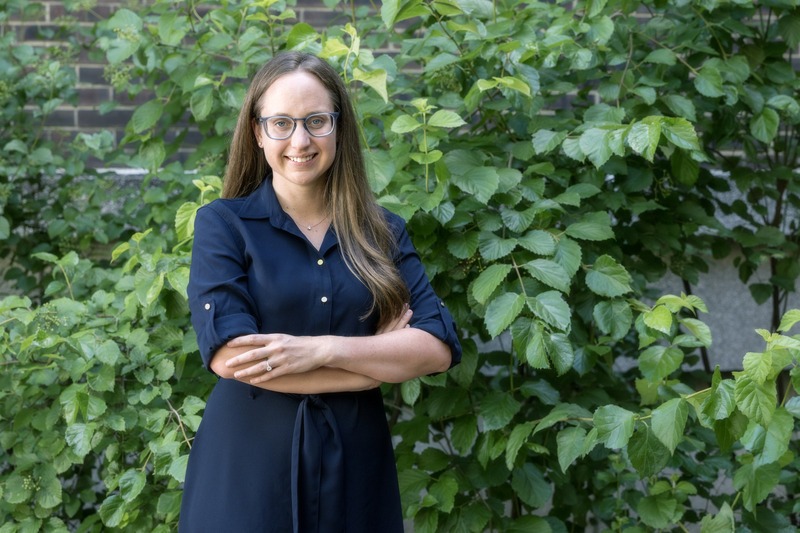
That approach—shaping materials using controlled flows—sits at the center of Alexandra Bayles’ research at the University of Delaware. Bayles, an assistant professor of chemical and biomolecular engineering and UD alumna, leads a laboratory that develops new devices to sculpt the microstructure of soft materials and thereby enhance their performance.
One June 24, Bayles will deliver an invited lecture at the 100th American Chemical Society Colloids and Surface Science Symposium as the recipient of the Unilever Award for Outstanding Young Investigator in Colloid and Surfactant Science, which recognizes early-career work with both scientific merit and clear industrial relevance. She received the award in 2025 but was on maternity leave at the time, making this year’s symposium—held at UD—her opportunity to deliver the formal lecture.
“Receiving this recognition means a great deal because it’s awarded by a community of both academic and industrial scientists who recognize not only the quality and rigor of our research, but also its utility at commercial scales,” Bayles said.
The science of sculpting flow
The Bayles lab has pioneered a technique called advective assembly, in which multiple streams of fluid are guided through engineered channel networks that organize them into precise, repeating patterns. Rather than blending materials into a uniform mixture, advective assembly extruders arrange contrasting components in flow. By tuning channel geometry and input feeds, Bayles’ team can template a material’s internal architecture before it ever reaches its final form.
Advective assembly can continuously and quickly structure materials, organizing them into hundreds of ultra-thin layers or voxels in a single pass. Because this approach exploits fluid mechanics rather than chemistry to build structure, it can be applied across a wide range of materials with similar flow properties, from food pastes and emulsions to hydrogels and biological inks.
Current projects in the lab span AI-enhanced 3D printing to environmentally friendly manufacturing of emulsions and surfactants. Bayles’ National Science Foundation Faculty Early Career Development (CAREER) award supports systematic work exploring how advective assembly principles can be used to address a long-standing challenge in 3D printing: preserving fine resolution at fast printing speeds.
“By developing fundamental insights into the physics of these pasty materials, we can tackle many potential applications,” Bayles said. “I love talking with engineers in wildly different industries, learning about their challenges, and brainstorming how these tools might be used.”
A culture of translation
UD has provided a strong platform for translating discoveries in fluid mechanics into industrially relevant applications. Since joining UD, Bayles has been invited to speak about her research at five different corporations, and she and her students have co-filed patents with UD’s Office of Economic Innovation and Partnerships. As part of the Unilever Award, she delivered an invited lecture to the company’s global research and development team, helping establish a direct line between her lab and one of the world’s largest consumer products companies.
“UD has a long history of industry partnerships—it’s baked into the culture here,” Bayles said. “There’s a shared understanding that applied research and fundamental research feed one another.”
Bayles first encountered that culture as an undergraduate at UD. Working in Professor Eric Furst’s lab on a project sponsored by Procter & Gamble, she became captivated by the idea that new experimental approaches developed at the bench scale could generate products used by millions of people. The collaboration resulted in two patents and several publications. From there, graduate work at the University of California, Santa Barbara, and a postdoctoral fellowship at ETH Zürich set the foundation for a research career that has expanded across formulation science, manufacturing, bioprinting, and complex fluid characterization.
Now back at the institution where her career began, she is shaping the next generation with the same spirit. She encourages her team to connect their research to broader scientific and societal questions, and to practice articulating its real-world potential.
“I try to emphasize creativity, curiosity, and not being afraid to take risks,” she said. “By practicing these skills, the researchers trained at UD are poised to make a positive impact in the world.”